
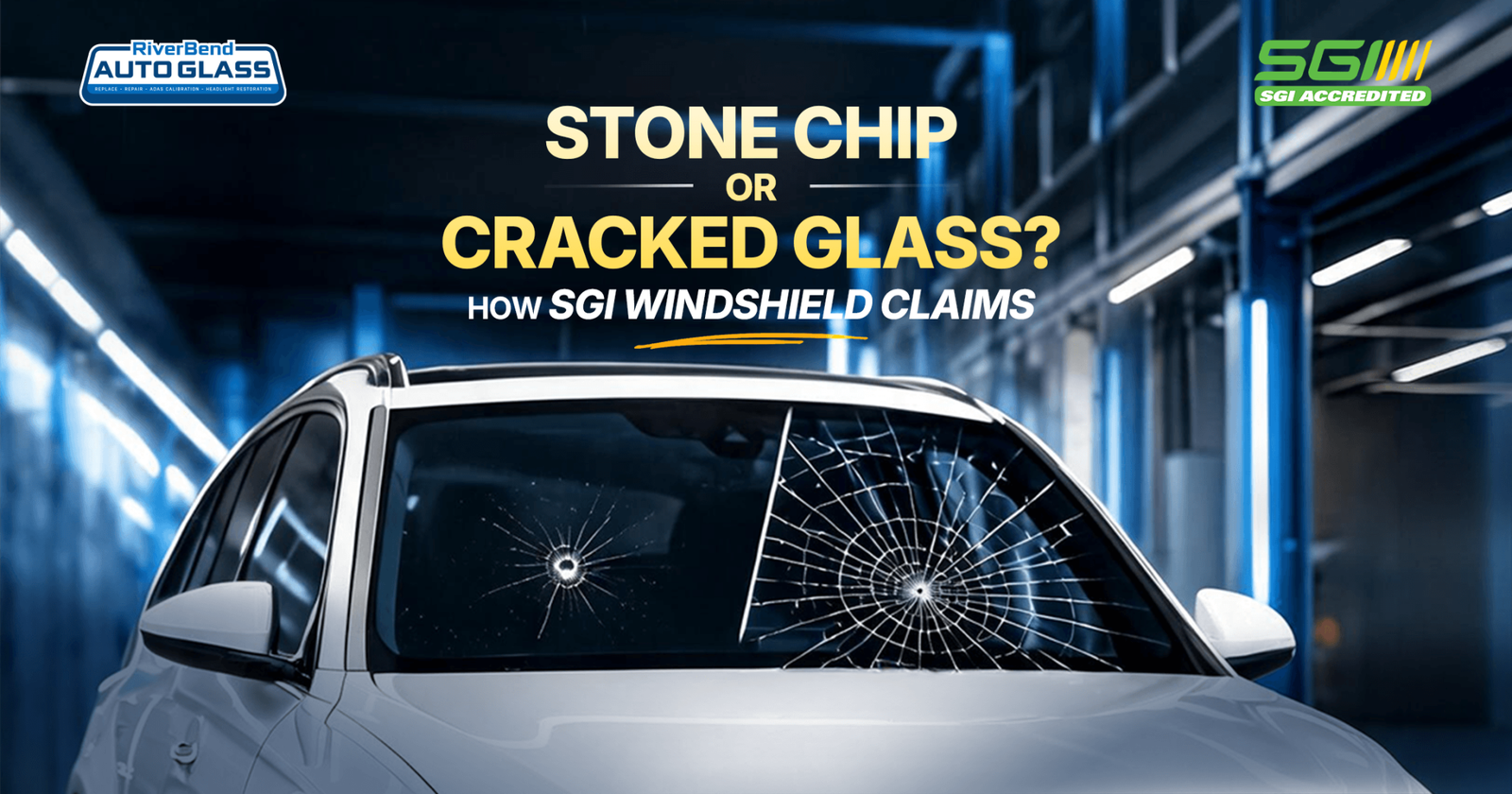
A rock hits your windshield on the highway, leaving a small stone chip or crack. In Saskatchewan, this is common due to gravel roads, winter sand, construction debris, and extreme temperature changes. What seems minor can quickly spread into a major crack requiring full replacement.
The difference is significant: chips can often be repaired for $50–150, while full replacements may cost $300–1,000 or more. Driving with impaired visibility is also illegal in Saskatchewan and can result in fines.
Understanding SGI windshield claims helps you decide when to repair, replace, or file a claim. This guide explains the process, costs, and how quick action can save you money and ensure safety.
What Causes Windshield Damage?
Windshield damage is mainly caused by stone chips from gravel roads, highway debris, sanding, and construction zones, as well as cracks from temperature changes, untreated chips spreading, accidents, and structural stress common in Saskatchewan conditions.
Stone Chips
Stone chips are the most common form of windshield damage. A small rock, pebble, or piece of gravel strikes the glass at highway speed, creating a small pit, bullseye, or star break. While the initial damage may seem minor, the chip creates a weak point in the glass.
- Gravel roads and highway debris. Saskatchewan has thousands of kilometres of gravel roads. Loose stones are easily kicked up by your own tires or by the vehicle ahead. Even on paved highways, debris from construction zones, uncovered loads, and tire treads can become projectiles.
- Winter road sanding materials. During winter, municipalities spread sand and small gravel on icy roads to improve traction. This material is abrasive and can easily chip your windshield. The combination of winter sand and high‑speed traffic creates constant exposure.
- Construction zones. Road construction is a fact of life in Saskatoon and surrounding areas. Construction zones often have loose gravel, dirt, and debris that can be kicked up by vehicles. Reduced speed limits may not prevent chips; a slow‑moving rock can still damage glass.
Cracked Windshields
A crack is more serious than a chip. Cracks can result from untreated chips that spread, temperature extremes, accidents, or structural stress.
- Temperature changes. Saskatchewan’s extreme temperature swings are brutal on auto glass. When the temperature drops below freezing, your windshield contracts. When you start your car and turn on the defroster, the glass near the vent heats rapidly while the rest stays cold. This temperature difference creates thermal shock. A chip that was stable at 10°C can crack within minutes at -20°C. Even a windshield with no visible damage can develop a stress crack from extreme temperature swings.
- Untreated stone chips spreading. A small chip is vulnerable. Temperature changes, road vibrations, and normal driving stress all pull that chip toward becoming a long crack. The difference between a repairable chip and a non‑repairable crack can be a single day. One cold night with the defroster blasting is all it takes.
- Accidents or impact damage. A collision—even a minor fender bender—can crack your windshield. The force of the impact transfers through the vehicle’s frame, stressing the glass. Side‑impact collisions are particularly damaging to windows, but even a front‑end collision can crack the windshield if the frame twists slightly.
- Structural stress. Over time, the frame of your vehicle can flex slightly from normal driving. Potholes, rough roads, and even slamming doors can stress the windshield. If the glass already has a small chip, that stress can cause it to crack.
Stone Chip or Cracked Glass: What’s the Difference?
Stone chips are small, localized damage that can often be repaired, while cracks are longer structural breaks that usually require replacement. The size, location, and severity determine repair eligibility, urgency, and SGI coverage, with cracks posing higher safety risks.
Size and Severity Comparison
A stone chip is typically smaller than a loonie (approximately 25mm in diameter). It may look like a bullseye, a star, or a small pit. The damage is usually confined to the outer layer of the glass. A chip is repairable if it has not penetrated both layers of glass and is not in the driver’s direct line of sight.
A crack is a linear fracture in the glass. Cracks can be short (under 6 inches) or long (over 12 inches). They can be straight, curved, or spider‑webbed. Cracks often start from an untreated chip that spreads due to temperature changes or road vibrations. A crack that has reached the edge of the windshield or has penetrated both layers of glass is not repairable.
When a Repair Is Possible
Repair is possible when the damage is minor. Industry guidelines for repairable damage include:
- Chips smaller than a loonie (approximately 25mm)
- Cracks shorter than 6‑12 inches (varies by technician and location)
- Damage confined to the outer layer of glass
- Damage not in the driver’s direct line of sight
- Damage not reaching the edge of the windshield
A repair involves injecting a clear resin into the damaged area under pressure. The resin fills the chip or crack, bonds with the glass, and restores clarity. The repair prevents the damage from spreading. The process takes 30‑45 minutes. You can drive away immediately. Most insurance policies cover chip repair with little or no deductible, especially if you have Auto Pak with Road Hazard Glass coverage.
When Full Replacement Is Necessary
Full replacement is required when the damage is too severe for safe repair. Indicators include:
- Cracks longer than 6‑12 inches
- Cracks in the driver’s direct line of sight
- Cracks reaching the edge of the windshield
- Damage penetrating both layers of glass
- Multiple chips clustered together (more than 3‑4 in a small area)
- Severe shattering or spider‑webbing
- Previous repairs that have failed
Replacement involves removing the damaged windshield, cleaning the frame, applying primer and high‑strength urethane adhesive, and installing new OEM‑quality glass. The process takes 60‑90 minutes plus adhesive curing time (minimum 1 hour). For vehicles with ADAS (Advanced Driver Assistance Systems), recalibration adds 30‑90 minutes.
Safety Risks of Ignoring Damage
Ignoring a small chip or crack is dangerous. A chip that is not repaired can spread into a long crack with temperature changes or road vibrations. A crack directly in the driver’s line of sight can hide pedestrians, cyclists, or vehicles braking suddenly. Night driving makes these obstructions worse, as oncoming headlights reflect off crack edges.
A damaged windshield is also structurally weaker. In a rollover accident, a properly bonded windshield provides up to 45% of the cabin’s structural strength. A cracked windshield may not provide that protection. In a frontal crash, the passenger‑side airbag rebounds off the windshield. If the windshield is cracked, the airbag may not deploy correctly.
Driving with a damaged windshield is also illegal in Saskatchewan if the crack impairs visibility or is larger than 50mm (about 2 inches) in the wiper‑swept area. Since 2018, police have issued over 43,000 warnings and 8,300 tickets for cracked windshields.
Does SGI Cover Windshield Damage?
Yes, SGI covers windshield damage under basic plate insurance, but your out-of-pocket cost depends on your deductible and Auto Pak coverage. Coverage varies for chip repairs versus full replacements under comprehensive insurance options.
Overview of SGI Auto Glass Coverage
SGI’s basic plate insurance includes coverage for damage to your vehicle, including your windshield. This coverage applies to incidents such as stone chips, cracks, and other damage caused by road hazards. However, your standard deductible applies. For most light vehicles (cars, SUVs, light trucks, vans), the standard deductible is currently $700∗∗.This is set to increase to∗∗$950 effective January 1, 2027.
If you have an Auto Pak (extension policy), you may have a lower glass‑specific deductible. For as little as $12 per month, you can lower your deductible to $350. With the Road Hazard Glass endorsement, your glass deductible can be as low as $50 or even 0 for chip repairs .
Comprehensive Insurance Explanation
Damage to your windshield from road hazards (stones, gravel, debris) falls under comprehensive coverage. Comprehensive coverage protects against non‑collision events: theft, vandalism, fire, hail, falling objects, and glass damage. Your basic plate insurance includes comprehensive coverage, subject to your deductible.
If you have an Auto Pak, your comprehensive coverage may be enhanced with lower deductibles and additional benefits like loss of use (rental car coverage) while your vehicle is being repaired.
Deductible Considerations
Your deductible is the amount you pay out of pocket before SGI covers the remaining cost. For a windshield chip repair costing
$80‑150, if your deductible is $700, filing a claim makes no financial sense. You would pay the full repair cost yourself, and the claim would not meet your deductible.
For a windshield replacement costing $500,with a $700 deductible, you also pay the full amount yourself. SGI pays nothing. This is why many drivers opt for Auto Pak coverage with a lower glass deductible.
If you have an Auto Pak with a 50 glass deductible, a $500 replacement would cost you only 50out of pocket. A chip repair might cost 0.
To check your deductible: Look at your SGI policy documents or contact your insurance broker. Ask specifically: “Do I have Road Hazard Glass coverage? What is my glass deductible?”
Repair vs Replacement Coverage Differences
Repair (chip repair): If you have Auto Pak with Road Hazard Glass coverage, your chip repair may cost nothing out of pocket (or a very low deductible). Without Road Hazard Glass, your standard deductible applies, making chip repair not worth claiming. Many drivers choose to pay for chip repairs themselves ($50‑150) rather than file a claim.
Replacement: Your deductible applies regardless of whether you have Auto Pak (though the amount may be lower). Under the basic plate alone, you pay the first $700(soon $950) of any replacement. With Auto Pak and Road Hazard Glass, you pay your glass deductible (often $50‑350). Without this coverage, you face the standard deductible.
Important note: For windshield damage from road hazards, SGI’s direct‑to‑shop process allows you to go straight to an SGI‑accredited glass shop. The shop files your claim on your behalf. You do not need to call SGI or file an online claim first. For side or rear window damage, you must file an Auto eClaim online or call SGI first.
How SGI Windshield Claims Work
SGI windshield claims are simple: visit an SGI-accredited shop, and they handle the claim for you. The process includes damage inspection, claim submission, repair or replacement, and payment of your deductible, with no need to contact SGI directly for most road damage.
Step 1: Inspect the Damage
The first step is determining whether your windshield can be repaired or needs full replacement. Small chips (smaller than a loonie) and short cracks (under 6‑12 inches) are usually repairable, provided the damage is not in the driver’s direct line of sight and has not reached the edge of the windshield. Cracks longer than 6‑12 inches, cracks in the driver’s line of sight, cracks reaching the edge, or damage penetrating both layers of glass require replacement.
Act quickly. A small chip can spread into a long crack in a single day, especially during Saskatchewan’s extreme temperature swings. The difference between a $80 repair and a $500 replacement can be a single cold night with the defroster blasting.
Step 2: Contact an SGI‑Accredited Glass Shop
Choose an SGI‑accredited auto glass shop. Accredited shops are certified to handle SGI claims directly, use certified technicians and OEM‑quality materials, offer direct billing (you pay only your deductible), and warranty their work for a minimum of 1 year . Non‑accredited shops cannot use SGI’s electronic dispatch system and require you to pay upfront and seek reimbursement later. Riverbend Autoglass is an SGI‑accredited shop serving Saskatoon. We offer shop service and mobile service.
Step 3: Start the Claim
When you arrive (or when we come to you), we will ask for your driver’s licence and vehicle registration. We will also ask for your SGI policy number (especially if you have Auto Pak with Road Hazard Glass coverage). We verify your coverage and deductible using our direct access to SGI’s electronic systems. We file your claim directly with SGI on your behalf. You do not need to call SGI or fill out online forms.
Step 4: Repair or Replacement Process
For chip repair: Our technician cleans the damaged area, injects a clear resin under pressure, and cures it with UV light. The resin bonds with the glass, restoring clarity and preventing the chip from spreading. The process takes 30‑45 minutes. You can drive away immediately.
For full replacement: Our technician removes the damaged windshield, cleans the frame, applies primer and high‑strength urethane adhesive, and installs new OEM‑quality glass. The vehicle must sit for at least one hour to allow the adhesive to cure before driving. For vehicles with ADAS (Advanced Driver Assistance Systems), we recalibrate the cameras and sensors after replacement, adding 30‑90 minutes.
Step 5: Payment and Deductibles
We offer direct billing to SGI. You only pay your deductible at pickup. If you have Auto Pak with Road Hazard Glass coverage, your glass deductible may be as low as $50 or even 0 for chip repairs. Under basic plate insurance alone, your deductible is
$700 (increasing to $ 950 on January 1, 2027). We verify your coverage and deductible before any work begins, so there are no surprises.
When Windshield Repair Is Usually Possible
Windshield repair is usually possible for small chips, early-stage damage, and short cracks that have not spread. Repairs are most effective when the damage is not in the driver’s direct line of sight and has not compromised structural integrity.
Small Chips Under Certain Sizes
A stone chip is typically repairable if it is smaller than a loonie (approximately 25mm in diameter). Bullseye chips, star breaks, and combination breaks of this size can usually be repaired. The resin used in the repair process flows into the damaged area and bonds with the glass, restoring clarity and structural integrity. If the chip is larger than a loonie, or if the damage has multiple radiating cracks, repair may not be possible.
Damage Not in Driver’s Direct Line of Sight
Even a perfect resin repair leaves a small scar. In certain lighting conditions (bright sunlight, night driving with oncoming headlights), that scar can create glare or distortion. For this reason, any chip or crack directly in the driver’s line of sight should be replaced, not repaired. Damage located low on the windshield near the hood, high above the driver’s eye line, or on the passenger side is generally safe to repair.
Early‑Stage Chips Without Spreading
The best time to repair a chip is as soon as you notice it. A fresh chip that has not yet begun to spread is the ideal candidate for repair. Once the chip has started to crack (even a small hairline crack extending from the chip), the repair becomes more difficult. The resin may not fill the entire crack, and the damage may continue to spread over time. If you see a chip, do not wait. Repair it immediately.
Benefits of Repairing Instead of Replacing
- Lower cost: Chip repair typically costs $50‑150. Full windshield replacement costs $300‑1,000 or more.
- Faster: Repair takes 30‑45 minutes. Replacement takes 2‑3 hours (including adhesive curing time).
- No insurance claim (often): If your deductible is high (e.g., $700), paying out of pocket for a $80 repair is cheaper than filing a claim. If you have Auto Pak with Road Hazard Glass coverage, your repair may cost $0.
- Preserves original glass: Your factory windshield has a perfect fit, proper seals, and optimal optical clarity. Repair preserves that original installation.
- No ADAS recalibration needed: Most windshield repairs do not require recalibration of Advanced Driver Assistance Systems (ADAS). Replacement often requires recalibration, adding $100‑300 and 30‑90 minutes.
- Environmentally friendly: Repairing extends the life of your existing windshield, keeping it out of the landfill.
When Full Windshield Replacement Is Needed
Full windshield replacement is needed for long or spreading cracks, multiple impact points, edge damage, or any cracks affecting visibility or safety systems. These issues weaken structural integrity and cannot be safely or effectively repaired.
Long or Spreading Cracks
Once a crack exceeds 6‑12 inches, repair is no longer reliable. The resin may not bond properly across the entire length, and the crack will continue to spread under temperature changes and road vibrations. A crack that is actively spreading (you notice it getting longer day by day) requires immediate replacement. In Saskatchewan’s extreme climate, a small crack can grow inches overnight. Do not wait.
Multiple Damaged Areas
A windshield with multiple chips clustered together (more than 3‑4 within a 6‑inch radius) is structurally compromised. Each chip is a weak point. Repairing them individually leaves the glass with multiple resin‑filled areas, which may not bond perfectly. The cumulative effect of several repairs may also impair visibility. In most cases, multiple chips require full windshield replacement.
Edge Cracks
The edge of the windshield carries significant structural load, helping hold the glass in place during normal driving and especially during a crash. A crack that reaches the edge of the windshield weakens the entire glass. Repair resin injected near the edge may not cure properly or may leak out before bonding. Worse, a repaired edge crack could fail suddenly, leaving you with a compromised windshield. Any damage reaching the edge requires full replacement.
Damage Affecting Visibility or Safety Systems
- Driver’s line of sight: Any chip or crack directly in front of the driver should be replaced, not repaired. Even a small scar from a repair can create glare or distortion. Your vision is too important to risk.
- ADAS camera area: Many modern vehicles have forward‑facing cameras mounted on or behind the windshield. These cameras are used for lane departure warning, automatic emergency braking, traffic sign recognition, and adaptive cruise control. If a crack or chip affects the camera’s view, replacement is required. Even if the glass is repairable, any distortion or residue from the repair resin could interfere with camera accuracy.
- Wiper‑swept area: Saskatchewan regulations prohibit cracks longer than 50mm (about 2 inches) in the area swept by your windshield wipers. If your crack exceeds this limit, replacement is required to avoid a ticket and ensure clear visibility during rain or snow.
Understanding ADAS Recalibration After Windshield Replacement
ADAS systems use cameras and sensors (often mounted on the windshield) for features like lane assist and emergency braking. After replacement, recalibration is required to ensure these systems work accurately and safely, preventing errors in critical driving assistance features.
What ADAS Means
ADAS stands for Advanced Driver Assistance Systems. These electronic systems use sensors to detect hazards, warn the driver, and sometimes take action to avoid a collision. Common ADAS features include:
- Lane departure warning (LDW) and lane keep assist (LKA) – uses a forward‑facing camera to monitor lane markings.
- Automatic emergency braking (AEB) – uses radar and cameras to detect obstacles and apply brakes.
- Adaptive cruise control (ACC) – uses radar to maintain a safe following distance.
- Traffic sign recognition (TSR) – uses a camera to read speed limit signs.
- Blind spot monitoring (BSM) – uses radar sensors in the rear bumper.
These systems save lives. But they are only accurate when their sensors are properly aligned.
Why Recalibration Is Important
The forward‑facing camera is attached to the windshield bracket. When the old windshield is removed and new glass installed, the camera’s position changes relative to the road. The replacement glass may have different optical properties. The mounting bracket may seat differently. Even a tiny shift—a fraction of a degree—affects the camera’s view.
Without recalibration, you may experience:
- Lane departure warning triggering when you are centred in the lane, or not triggering when you drift.
- Automatic emergency braking failing to detect obstacles.
- Adaptive cruise control maintains the wrong following distance.
- Traffic sign recognition displaying incorrect speed limits.
- Dashboard warning lights indicating system malfunctions.
Some vehicles will display a warning message after windshield replacement. Others give no warning at all—the system simply fails silently. Do not assume your safety systems are working.
Vehicles Commonly Requiring Recalibration
Almost all vehicles with ADAS features require calibration after windshield replacement. This includes most cars, trucks, and SUVs built since 2015‑2017, and virtually all new vehicles sold today. Brands such as Honda, Toyota, Ford, GM, BMW, Mercedes‑Benz, Audi, Volvo, Subaru, Hyundai, Kia, and Tesla all use forward‑facing cameras for ADAS features. Even base models often include a rearview camera and forward collision warning. Check your owner’s manual or consult a professional.
Safety Risks of Skipping Calibration
A miscalibrated ADAS system is worse than no system at all. It can give you false confidence. You may rely on automatic emergency braking that does not work. You may trust lane keep assist that is misaligned. In a true emergency, these systems may react too late, too early, or not at all.
Skipping calibration also has legal implications. If you are involved in an accident and it is discovered that your ADAS system was not recalibrated after a windshield replacement, your insurance company may deny coverage. You could be held liable for damages that a properly functioning system could have prevented.
Tips to Avoid Future Windshield Damage
Reduce windshield damage by keeping distance from gravel trucks, avoiding sudden temperature changes, repairing chips immediately, and driving cautiously in construction zones. These habits help prevent small impacts from turning into costly cracks.
Keep Distance from Gravel Trucks
The most common cause of windshield chips is flying debris from other vehicles. Gravel trucks, dump trucks, and construction vehicles are the worst offenders. Loose rocks bounce off their tires or spill from their loads. When you follow too closely, those rocks hit your windshield at highway speed.
Maintain at least 4‑5 seconds behind any truck carrying loose material. On gravel roads or highways with debris, increase your distance to 6‑8 seconds. This gives rocks time to fall back to the ground before you reach them. Avoid driving directly behind or beside gravel trucks. Pass quickly and safely when possible, or drop back to a safe distance.
Avoid Sudden Temperature Shifts
Saskatchewan winters are brutal on auto glass. Extreme cold followed by sudden heat creates thermal shock, the leading cause of crack growth. Warm your windshield gradually. Do not blast maximum defroster on a frigid windshield. Start with low heat and fan speed. Gradually increase temperature over several minutes. This gives the glass time to warm evenly, reducing stress on any existing chips.
Never pour hot water on an icy windshield. The sudden temperature change causes rapid expansion and almost guaranteed cracking. Use an ice scraper or de‑icer spray instead.
Fix Small Chips Immediately
A small chip that costs $80 to repair today can become a long crack requiring $500 replacement next month. Every day you wait, that chip is under stress from temperature changes, road vibrations, and normal driving. The difference between a repairable chip and a non‑repairable crack can be a single day. One cold night with the defroster blasting is all it takes.
Keep a few local auto glass shop numbers saved in your phone. As soon as you notice a chip, call and book an appointment. The same week is fine. Do not wait until next month.
Drive Carefully in Construction Zones
Road construction is a fact of life in Saskatoon and surrounding areas. Construction zones often have loose gravel, dirt, and debris that can be kicked up by vehicles. Reduced speed limits may not prevent chips; a slow‑moving rock can still damage glass.
When driving through construction zones, increase your following distance. The vehicle ahead of you may kick up debris. Watch for warning signs about loose gravel. If possible, avoid the lane closest to construction activity. Reduce your speed (even below the posted limit if conditions warrant) to minimise the force of any impact.
Common Mistakes Drivers Make with SGI Glass Claims
Drivers often delay repairs, choose non-accredited shops, ignore small cracks, or assume full insurance coverage. These mistakes can increase costs, reduce safety, and lead to larger windshield damage over time.
Waiting Too Long to Repair Chips
A small stone chip looks harmless. You think you have weeks to deal with it. But every day you wait, that chip is working against you. Temperature changes, road vibrations, and normal driving stress are all pulling that chip toward becoming a long crack. In Saskatchewan’s extreme climate, a chip can spread inches overnight when the temperature drops and your defroster creates thermal shock.
The difference between a repairable chip ($80‑150)and a full replacement ($300‑1,000+) can be a single day. Do not wait. Repair chips within 24‑48 hours of noticing them. The same week is acceptable. Do not wait until next month.
Choosing Non‑Accredited Shops
You find a cheap deal online. A non‑accredited shop offers a low price. You save a few dollars upfront. But non‑accredited shops cannot offer direct billing to SGI. You pay the full cost upfront and wait weeks for reimbursement. They may not have the proper training or equipment for ADAS recalibration. They may not warranty their work.
SGI‑accredited shops, like Riverbend Autoglass, offer direct billing (you pay only your deductible), certified technicians, OEM‑quality materials, and warranty protection. The small upfront savings from a non‑accredited shop are not worth the risk.
Ignoring Small Cracks
A small crack that is not in your direct line of sight may seem minor. But cracks spread. Temperature changes, potholes, and normal driving stress cause them to grow. A crack that reaches the edge of the windshield weakens the entire glass. A crack that enters the driver’s line of sight impairs visibility and is illegal.
Do not ignore any crack, no matter how small. Have it assessed by a professional. If it is repairable, repair it immediately. If it requires replacement, schedule it promptly. Ignoring a crack only makes the problem worse and more expensive.
Assuming All Damage Is Fully Covered
Many drivers assume their SGI basic plate insurance covers all glass damage with no out‑of‑pocket cost. This is not true. Your basic plate deductible is $700 (increasing to $950 on January 1, 2027). If your repair or replacement costs less than your deductible, you pay the full amount. SGI pays nothing.
If you have Auto Pak with Road Hazard Glass coverage, your glass deductible may be as low as 50 or even 0 for chip repairs. But you must check your policy. Do not assume. Call your broker and ask: “Do I have Road Hazard Glass coverage? What is my glass deductible?” Knowing your coverage before you file prevents surprises at the repair shop.
FAQs About SGI Windshield Claims
Does SGI waive deductibles for stone chip repairs?
Under basic plate insurance alone, no. Your 700 deductible applies. If you have Auto Pak with Road Hazard Glass coverage, your chip repair may have a lower deductible (often $50 or 0).Check your policy. Even without coverage,paying $80‑150 out of pocket is cheaper than filing a claim against a $700 deductible.
Can I choose my own repair shop?
Yes, you can choose any shop. However, SGI strongly recommends using an SGI‑accredited shop. Accredited shops offer direct billing (you pay only your deductible), certified technicians, OEM‑quality materials, and warranty protection. Non‑accredited shops require you to pay upfront and seek reimbursement later, and they may not have the proper equipment for ADAS recalibration.
How long does windshield replacement take?
A full replacement takes 60‑90 minutes for the installation, plus at least one hour of adhesive curing time before you can drive. Total time: approximately 2‑3 hours. Chip repairs take 30‑45 minutes with no curing wait. ADAS recalibration adds 30‑90 minutes if your vehicle is equipped.
Will my insurance rates increase?
Generally, no. Glass claims filed under comprehensive coverage (road hazards, stone chips) do not affect your SGI safe driver rating or insurance premiums. However, multiple claims within a short period could signal higher risk and might affect your rates. If the glass damage is part of an at‑fault collision claim, that claim will affect your premiums.
Can I drive immediately after replacement?
No. The urethane adhesive needs time to cure and reach full strength. Driving too soon can shift the windshield out of position or compromise the seal. Your technician will tell you the required curing time, typically one hour. Avoid car washes, high‑pressure hoses, and slamming doors for 24 hours.
Conclusion
Your windshield is essential for safety, supporting cabin strength, airbag deployment, and visibility. Even small chips can quickly become dangerous cracks, especially in Saskatchewan’s extreme climate, and driving with impaired visibility can lead to fines.
SGI windshield claims are simple: visit an SGI-accredited shop, and they handle the claim directly with SGI. You pay only your deductible (if applicable), while certified technicians complete repairs using OEM-quality materials and proper ADAS calibration.
Early repair is critical. Small chips can quickly turn into costly replacements, so act within 24–48 hours to avoid higher expenses and safety risks.
SGI-accredited shops provide certified work, direct billing, and warranty protection for peace of mind. Contact Riverbend Autoglass today for fast, reliable windshield repair or replacement and drive safely with confidence.