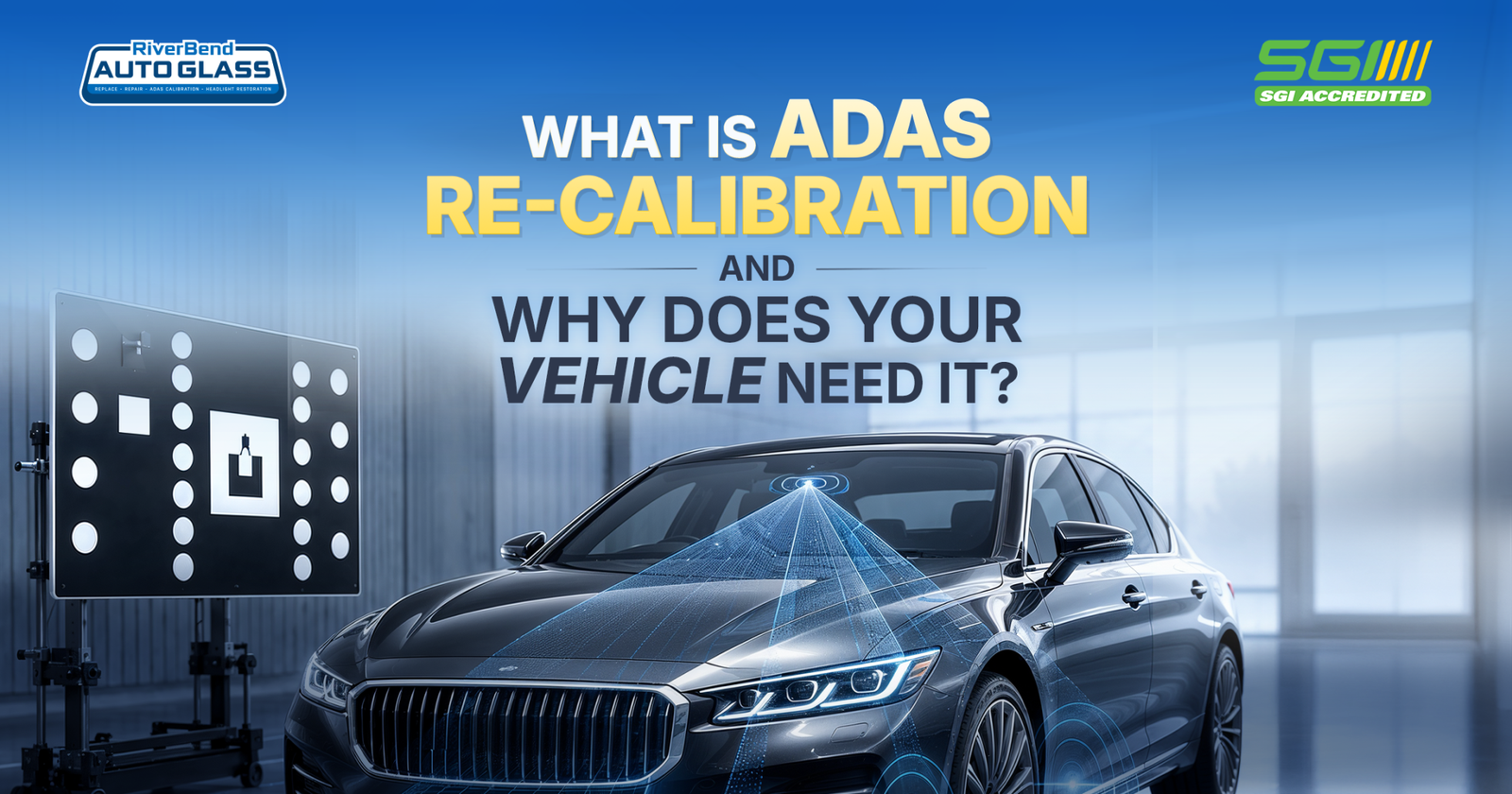
Modern vehicles rely on Advanced Driver-Assistance Systems (ADAS) like lane-keeping assist, automatic emergency braking, adaptive cruise control, and blind-spot monitoring to improve safety. These systems use cameras, radar, and sensors that must remain precisely aligned to function correctly.
After windshield replacement, collision repair, or suspension work, these sensors can shift slightly out of position. Even a minor misalignment may cause inaccurate warnings or system failure. Because many ADAS cameras are mounted near the windshield, recalibration is often required after glass replacement.
ADAS recalibration restores sensor accuracy so your vehicle’s safety features work as intended. Proper calibration helps ensure reliable detection, safer driving, and full performance of modern driver-assistance technology.
In this guide we will learn What Is ADAS Re-Calibration and Why Does Your Vehicle Need.
What Is ADAS?
ADAS improves safety by continuously monitoring the road with cameras, radar, and sensors. These systems detect hazards like sudden braking, pedestrians, or lane drifting and can warn the driver or automatically assist with steering and braking to help prevent accidents.
ADAS also improves driving convenience. Adaptive cruise control maintains safe following distances automatically, parking assist simplifies tight maneuvers, and blind-spot monitoring alerts you to vehicles outside your view.
Common ADAS Features
Lane Departure Warning (LDW) uses a forward-facing camera to monitor lane markings. If you begin to drift out of your lane without signaling, the system alerts you with a visual, audible, or haptic (steering wheel vibration) warning. Lane Keeping Assist (LKA) goes further by gently steering you back into the lane.
Forward Collision Warning (FCW) continuously monitors the distance between your vehicle and the vehicle ahead. If the system detects a potential collision, it alerts you with visual and audible warnings, giving you time to brake or take evasive action.
Automatic Emergency Braking (AEB) is the next level beyond FCW. If the system determines a collision is imminent and you do not react in time, AEB automatically applies the brakes to reduce impact severity or avoid the crash entirely. Some systems also detect pedestrians and cyclists.
Adaptive Cruise Control (ACC) maintains a set speed while also adjusting to the traffic ahead. Using radar or cameras, ACC keeps a safe following distance—slowing down when traffic slows and accelerating back to your set speed when the road clears. Advanced systems can bring the vehicle to a complete stop and resume in stop-and-go traffic.
Blind Spot Monitoring (BSM) uses radar sensors in the rear bumper to detect vehicles in your blind spots. When a vehicle is present, a warning light appears in your side mirror. Some systems also provide audible alerts if you activate your turn signal while a vehicle is in your blind spot.
Parking Assist uses ultrasonic sensors and cameras to help you park. Basic systems provide visual and audible warnings as you approach obstacles. Advanced systems (active park assist) can automatically steer your vehicle into parallel or perpendicular parking spots while you control the throttle and brakes.
Traffic Sign Recognition (TSR) uses a forward-facing camera to detect speed limit signs, stop signs, and other traffic signs. The system displays the detected signs on your dashboard or infotainment screen, helping you stay aware of current speed limits and regulations.
Rearview cameras are now mandatory on new vehicles in many jurisdictions. These cameras activate when you shift into reverse, displaying the view behind your vehicle on a central screen. Many systems also include dynamic guidelines that move as you turn the steering wheel.
Rear Cross-Traffic Alert (RCTA) warns you of approaching vehicles when backing out of a parking space. Using radar sensors in the rear bumper, RCTA detects vehicles, pedestrians, or obstacles crossing behind you—even when your view is blocked by larger vehicles parked on either side.
Driver monitoring systems use cameras to track the driver’s eye gaze and head position. If the system detects drowsiness or distraction, it provides alerts to refocus your attention on the road.
What Is ADAS Re-Calibration?
ADAS re-calibration is the process of precisely realigning your vehicle’s cameras and sensors after repairs or windshield replacement. It restores manufacturer-specified accuracy so safety systems like lane assist, collision warning, and blind-spot monitoring function correctly and reliably.
How sensors and cameras must be aligned accurately
ADAS cameras and sensors must be aligned with extreme precision to function correctly. Even a slight misalignment can cause lane departure warnings, adaptive cruise control, or blind-spot monitoring to behave inaccurately or fail entirely.
Manufacturers often require recalibration after windshield replacement, collision repair, suspension work, wheel alignment, windshield chip repair, or airbag deployment because these services can shift sensor positioning and affect system accuracy.
Difference between calibration and normal repair
Normal repair fixes the physical damage—replacing a windshield, repairing a bumper, realigning wheels. Calibration ensures that after the physical repair, your safety systems actually work correctly. You can replace a windshield perfectly, but if you do not recalibrate the cameras mounted on that windshield, your lane departure warning and automatic emergency braking may not function. The physical repair is visible. The calibration is invisible. Both are necessary.
Types of ADAS Calibration
Static Calibration is performed in a controlled shop environment. The technician places specialized targets or alignment boards at precise distances and angles around the vehicle. Using diagnostic scan tools, the technician triggers the calibration process. The vehicle’s onboard computer compares the sensor readings to the known target positions and adjusts its internal calculations to match. Static calibration requires a clean, level shop floor with proper lighting and specific clearance around the vehicle. The targets must be manufacturer-specific (different vehicles use different target patterns).
Static calibration is required for: Windshield-mounted cameras (lane departure, traffic sign recognition, automatic high beams), radar sensors (automatic emergency braking, adaptive cruise control), and ultrasonic sensors (parking assist).
Dynamic Calibration requires driving the vehicle under specific conditions. The technician drives the vehicle on a clear road with visible lane markings, at a specified speed (often 40-65 km/h or 25-40 mph), for a specified distance (typically 5-20 minutes). The vehicle’s onboard computers use live sensor data to automatically calibrate themselves. The driver may see a message on the dashboard indicating calibration is in progress. Dynamic calibration is often required for systems that learn over time, such as lane keep assist and adaptive cruise control.
Dynamic calibration is required for: Some forward-facing camera systems, adaptive cruise control (especially radar-based systems), and vehicles where static equipment is not available or not sufficient.
Combined Calibration means some vehicles require both static and dynamic calibration. The static calibration sets baseline alignment. The dynamic calibration fine-tunes the system based on real-world driving conditions. Combined calibration is becoming more common as ADAS systems become more sophisticated.
Which vehicles need calibration? Almost all vehicles with ADAS features require calibration after windshield replacement or collision repair. This includes most cars, trucks, and SUVs built since 2015-2017, and virtually all new vehicles sold today. Check your owner’s manual or consult a professional. Do not assume your vehicle is not equipped—many base models now include at least a rearview camera and forward collision warning.
When Does Your Vehicle Need ADAS Re-Calibration?
ADAS re-calibration is required after services or repairs that affect sensor alignment, including windshield replacement, collision repair, suspension or wheel alignment work, and camera or sensor replacement. These events can shift sensor positioning and reduce the accuracy of your vehicle’s safety systems.
After Windshield Replacement
This is the most common reason for ADAS calibration. Many ADAS components—especially forward-facing cameras for lane departure warning, traffic sign recognition, and automatic high beams—are mounted on or directly behind the windshield. When the windshield is removed and replaced, the camera’s position relative to the road changes slightly. The new glass may have different optical properties. The mounting brackets may seat differently. Even a tiny shift—a fraction of a degree—can affect the camera’s view.
The risk: Without ADAS recalibration after windshield replacement, safety systems may malfunction or fail silently. Lane departure warnings, automatic emergency braking, and adaptive cruise control can become inaccurate if cameras or sensors are misaligned. Some vehicles display warning messages, while others do not. Always request ADAS recalibration after replacing your windshield to ensure these systems work properly.
After Collision Repair
Even minor collisions can knock ADAS sensors out of alignment. A 5 mph fender bender may shift the bumper where blind-spot radar sensors are mounted. A parking lot scrape can misalign parking sensors. A more significant collision can shift the vehicle’s entire frame, affecting every sensor’s position. Structural repairs, bumper replacements, and bodywork all require recalibration.
The risk: A blind-spot monitoring sensor that is misaligned might not detect a vehicle in your blind spot. Rear cross-traffic alert may fail to detect approaching cars when backing out. Parking sensors may give false warnings or no warnings at all. Your insurance claim for collision repair should include ADAS calibration. Verify that your repair shop includes calibration in their estimate.
After Suspension or Wheel Alignment Work
Your ADAS sensors measure the vehicle’s position relative to the road. When you change suspension components or adjust wheel alignment, the vehicle’s ride height, angle, and steering geometry change. These changes affect the forward-facing camera’s view of the road, the radar sensor’s aim, and the steering angle sensor’s readings.
The risk: Lane keep assist may tug the steering wheel incorrectly because the camera sees lanes at the wrong angle. Adaptive cruise control may not maintain proper following distance because the radar is aimed incorrectly. The vehicle may pull to one side because the steering angle sensor is out of sync with the actual wheel position. Any suspension work—replacing struts, installing lowering springs, new control arms, wheel alignment—should trigger ADAS recalibration if your vehicle is equipped.
After Sensor or Camera Replacement
If an ADAS sensor or camera is damaged and replaced, the new component must be calibrated to the vehicle. A new forward-facing camera needs to learn the road geometry. A replacement radar sensor needs to be aligned with the vehicle’s centerline. Even if you replace a sensor with an identical part number, it will not function correctly until calibrated.
The risk: A new camera with default settings may misinterpret lane markings, traffic signs, or obstacle distances. The vehicle’s ADAS computer may not recognize the new sensor until calibrated. Some vehicles will display warning lights or error messages until calibration is completed.
Signs Your Vehicle May Need Re-Calibration
Signs your vehicle may need ADAS re-calibration include dashboard warning lights, inaccurate lane assist, unexpected braking alerts, adaptive cruise control issues, and unclear or obstructed camera views. These problems can indicate misaligned sensors or cameras affecting safety system performance.
ADAS Warning Lights on Dashboard
Modern vehicles display warning messages when ADAS systems are disabled or malfunctioning. Common messages include “Lane Departure Warning Unavailable,” “Forward Collision Warning Disabled,” “Adaptive Cruise Control Malfunction,” “Blind Spot Monitoring Not Available,” or a generic “Driver Assist System Malfunction” warning light. If these warnings appear after a windshield replacement, collision repair, or suspension work, calibration is almost certainly required. Do not assume the warning will clear on its own—it will not.
Lane Assist Not Working Properly
Lane keeps assist or lane departure warning functions by using a forward-facing camera to detect lane markings. If the camera is misaligned, these systems behave erratically. Signs of misalignment include the system tugging the steering wheel when you are centered in the lane, the system not activating when you drift out of the lane, inconsistent warnings on different roads (works on highway but not city streets), or the system disabling itself with a warning message.
Unexpected Braking or Alerts
Automatic emergency braking and forward collision warning rely on precise sensor alignment. A misaligned radar or camera can cause false positives—braking when there is no obstacle, or warning alerts with nothing ahead. False positives are dangerous. They can cause rear-end collisions if your vehicle brakes unexpectedly. They can startle you into making an unsafe maneuver. If your vehicle brakes or alerts for no apparent reason, have your ADAS calibration checked immediately.
Cruise Control Behaving Strangely
Adaptive cruise control maintains a safe following distance using radar or cameras. A misaligned sensor can cause the vehicle to follow too closely (dangerous), follow too far (allows other cars to cut in), accelerate and brake erratically, or disengage with a warning message. If your adaptive cruise control feels unpredictable, calibration may be needed.
Camera Visibility Issues
Some vehicles display the forward-facing camera view on the infotainment screen (for traffic sign recognition or dashcam features). If the camera image appears tilted, off-center, or shows parts of the windshield molding, the camera may have shifted during windshield replacement. Also look for black bars or blocked areas on the camera image—debris or misaligned trim may obscure the camera’s view.
Why ADAS Re-Calibration Is Important
ADAS recalibration is essential for safety, compliance, and liability. It ensures driver-assistance systems work correctly, meets manufacturer requirements, and helps prevent accidents caused by misaligned sensors after repairs or windshield replacement.
Safety Reasons
The most important reason for ADAS calibration is safety. These systems are designed to prevent collisions, reduce crash severity, and save lives. But they only work when properly calibrated.
Incorrect sensor readings can cause accidents. A forward-facing camera that is off by a fraction of a degree may not detect a stopped vehicle ahead. Your automatic emergency braking may not activate when you need it most. A blind-spot sensor that is misaligned may fail to alert you to a vehicle in your blind spot. A lane departure warning that triggers incorrectly could cause you to swerve unnecessarily. These failures are not hypothetical—they happen regularly when calibration is skipped.
Features may not react properly in emergencies. ADAS systems are designed to react faster than humans. But a miscalibrated system may react too late, too early, or not at all. In a true emergency, you need these systems to work perfectly. Any margin of error reduces their effectiveness. Calibration restores that margin to manufacturer specifications.
Manufacturer Requirements
Vehicle manufacturers are explicit: ADAS calibration is required after any repair that disturbs the sensors’ positions. This includes windshield replacement, collision repair, suspension work, wheel alignment, and sensor replacement.
Warranty implications: Skipping required calibration may void your vehicle warranty. If an ADAS-related failure occurs and you cannot prove calibration was performed, the manufacturer may deny coverage.
Owner’s manual guidance: Many owner’s manuals now include warnings about ADAS calibration after windshield replacement. Some even specify which repairs require dealer-only calibration. Ignoring these warnings violates the manufacturer’s instructions for safe vehicle operation.
Insurance & Liability
ADAS calibration also matters for insurance coverage and legal liability.
Insurance requirements: If you file a claim for windshield replacement or collision repair, your insurance company may require proof of ADAS calibration. Some policies explicitly cover calibration as part of the repair. If you skip calibration and later have an accident that could have been prevented by a properly calibrated ADAS system, your insurance company may deny coverage.
Repair shop liability: A shop that replaces a windshield or performs collision repair without completing required ADAS calibration may be liable for any resulting accidents. Many shops now include calibration as a standard part of their repair process—not as an upsell. If your shop does not mention calibration, ask why.
Driver liability: If you knowingly skip calibration and cause an accident that a properly functioning ADAS system could have prevented, you may face legal liability. Ignorance is not a defense—manufacturers and repair shops are increasingly publicizing calibration requirements.
What Happens If You Skip ADAS Calibration?
Skipping ADAS calibration can reduce safety performance, cause false or missed alerts, increase crash risk, and lead to insurance or liability issues. It may also result in higher long-term repair costs if problems go unnoticed.
Reduced Safety Performance
ADAS features are designed to help you avoid collisions. When sensors are misaligned, those features may not function at all. Your lane keep assist may not activate when you drift. Your automatic emergency braking may not detect the car that stopped suddenly ahead. Your blind-spot monitoring may not alert you to a vehicle in your blind spot. These are not minor inconveniences—they are critical safety functions that could save your life. When you skip calibration, you are driving without the full safety protection your vehicle is capable of providing.
False Warnings or Missed Hazards
A miscalibrated ADAS system can produce false warnings. Your forward collision warning may alert you to obstacles that are not there. Your lane departure warning may trigger when you are centered in your lane. False warnings are annoying. More dangerously, they can cause you to ignore warnings altogether. When a real hazard appears, you may not react because you have learned to dismiss the alerts.
Worse than false warnings are missed hazards. A camera that is tilted downward may not see a stopped vehicle ahead. A radar sensor that is aimed too high may not detect a pedestrian. A blind-spot sensor that is misaligned may not detect a vehicle beside you. These missed detections can lead directly to collisions.
Increased Accident Risk
The math is simple. Miscalibrated ADAS systems are less effective. Less effective safety systems increase your risk of being in an accident. If you are in an accident that could have been prevented by properly calibrated ADAS features, you bear responsibility for that outcome. Your insurance premiums may increase. You may face legal liability if others are injured. The consequences extend far beyond the cost of calibration.
Possible Insurance Complications
If you file a claim for windshield replacement or collision repair and your insurance policy requires ADAS calibration, skipping calibration may void your coverage. Your insurance company may deny a future accident claim if they discover calibration was skipped after a previous covered repair. Some policies explicitly exclude coverage for accidents caused by improper repairs, including skipped calibration.
Increased Long-Term Repair Costs
A delayed calibration does not save money. A misaligned camera that causes your vehicle to pull to one side may wear tires unevenly, requiring premature replacement. A miscalibrated adaptive cruise control that brakes aggressively may wear brake pads faster. The most expensive consequence is the accident itself. The cost of calibration is minimal compared to collision repair, medical bills, or increased insurance premiums.
How Long Does ADAS Calibration Take?
ADAS calibration time varies based on vehicle type, required calibration method (static or dynamic), and sensor condition. It typically takes from under an hour to several hours depending on system complexity and accuracy requirements.
Typical Timeframe
Static calibration in a shop environment typically takes 30 minutes to 2 hours. The technician must set up targets at precise distances, connect diagnostic equipment, and run the calibration procedure. Some vehicles calibrate quickly. Others require multiple steps and adjustments, extending the time.
Dynamic calibration requires driving the vehicle under specific conditions. The driving portion typically takes 15-30 minutes, plus travel time to a suitable road with clear lane markings. Combined calibration (static + dynamic) may take 1-3 hours total, including both shop time and road time.
Most calibration appointments can be completed within a half-day. Plan to leave your vehicle for 2-4 hours for static calibration. Dynamic calibration may require a technician to drive the vehicle for 15-30 minutes after shop work is complete.
Factors That Affect Calibration Time
Vehicle make and model is the biggest factor. Some manufacturers (Tesla, BMW, Mercedes-Benz) have complex calibration procedures that take longer. Others (Ford, Honda, Toyota) have streamlined processes. Luxury vehicles with more ADAS features generally take longer to calibrate than economy vehicles with basic systems.
Type of calibration affects duration. Static calibration is shop-only and typically takes 30-90 minutes. Dynamic calibration adds road time (15-30 minutes of driving). Combined calibration is the most time-consuming because it requires both shop setup and road testing.
Sensor condition also matters. If sensors are dirty, damaged, or misaligned due to collision damage, the technician may need extra time to clean, repair, or adjust them before calibration can begin. Sensor replacement adds significant time.
Why Professional Calibration Matters
ADAS calibration requires specialized tools, OEM software, and trained technicians to ensure accuracy. Professional calibration follows strict manufacturer standards, ensuring safety systems function correctly and reliably after repairs or windshield replacement.
Specialized Tools and Software Required
ADAS calibration requires advanced tools like OEM software, 3D camera systems, and laser-guided alignment equipment. Professional systems use precise digital targets and cloud-based vehicle data to ensure manufacturer specifications are met accurately.
These tools achieve millimeter-level precision, reducing setup errors and ensuring sensors are correctly aligned. Even a small misalignment can affect detection accuracy, making professional-grade equipment essential for safe and reliable ADAS performance.
Importance of Trained Technicians
Having the right equipment is only half the equation. The technician operating that equipment must be properly trained. The IMI (Institute of the Motor Industry) offers accredited ADAS calibration qualifications at Level 2 and Level 3, requiring significant guided learning hours and practical assessment .
What do these training programs cover?
- Working safely with vehicle ADAS systems (including high-voltage components)
- Understanding the correct procedures when working with ADAS vehicle systems
- Setting up the work environment to enable successful testing and calibration of ADAS systems
- Dynamic, static, and dynamic-static calibration principles and processes
- Diagnostic, removal, replacement, and recalibration of ADAS systems and components
A trained technician understands the relationships between vehicle manufacturers and aftermarket component producers regarding ADAS technical information . This knowledge is critical because different vehicle makes and models have different calibration requirements, target patterns, and specifications. An untrained technician may not recognize subtle variations that can compromise calibration accuracy.
OEM-Standard Calibration Procedures
Vehicle manufacturers publish specific calibration procedures for their vehicles. Professional calibration means following those procedures exactly, not taking shortcuts.
What does OEM-standard calibration require?
- Controlled environment: Static calibration requires a perfectly level floor, consistent lighting, and wide, clear zones around the vehicle . Parking lots or general shop bays rarely meet these tolerances.
- Target accuracy: OEMs demand laser-guided or proprietary target setups . Professional static calibration systems use targets positioned at precise distances and angles specified by the manufacturer.
- Proper documentation: OEM-standard calibration includes complete digital documentation of every step — from vehicle identification and fault code analysis to final calibration results . This documentation protects both the shop and the vehicle owner.
Why Drivers in Saskatoon Trust Riverbend Autoglass
Drivers in Saskatoon trust Riverbend Autoglass for precise windshield replacement and ADAS calibration. They focus on safety, using proper procedures to ensure vehicle systems are correctly aligned and safe to drive after service.
Mention:
- Professional Windshield Replacement: A windshield replacement isn’t just about removing broken glass. It’s about sealing the new glass correctly so that your car’s Advanced Driver Assistance Systems (ADAS) keep working. Riverbend Autoglass uses OEM-quality adhesives and follows strict installation standards to ensure your windshield bonds permanently and securely. This protects your car’s structural integrity in case of a collision.
- Advanced ADAS Calibration Equipment:Modern cars have cameras behind the windshield that read lane markings and detect obstacles. If the windshield is replaced without recalibrating these sensors, your safety features could fail. Riverbend invests in advanced electronic calibration tools and targets to realign these systems to factory standards. This resets your lane keep assist, automatic braking, and adaptive cruise control to function exactly as the manufacturer intended.
- Experienced Technicians: They don’t rely on guesswork. The team is trained specifically in the relationship between auto glass replacement and sensor alignment. They understand that every vehicle is different—a discrepancy of just a degree in the camera angle can cause a sensor to miss an object. Their skill ensures your systems act as a unified safety net, not just random electronics working independently.
- Fast and Reliable Service: They know you depend on your vehicle. Riverbend Autoglass offers same-day service for most makes and models, ensuring you’re back on the road quickly without sacrificing safety standards.
- Insurance Claim Assistance: Dealing with insurance after a cracked windshield can be a hassle. Riverbend works directly with insurance providers to handle the paperwork for your claim, including the crucial line item for ADAS recalibration.
- Trusted Local Service in Saskatoon: Saskatoon roads can be tough on windshields, and the local tech economy means more modern vehicles on the road. Riverbend Autoglass understands these local conditions and provides diagnostics and repairs that keep your vehicle road-safe and compliant with provincial safety standards. It’s why many Saskatoon drivers recommend them with confidence.
Need Windshield Replacement or ADAS Re-Calibration in Saskatoon?
Your vehicle’s safety systems are only as reliable as their calibration. A cracked windshield is more than an inconvenience—it’s a potential blind spot for the cameras and sensors that help protect you on the road. Don’t leave your safety to chance.
At Riverbend Autoglass, we understand the critical link between a properly sealed windshield and your vehicle’s Advanced Driver Assistance Systems (ADAS). When you choose us, you’re not just getting the glass replaced; you’re getting the peace of mind that your lane departure warnings, automatic emergency braking, and adaptive cruise control will function as the manufacturer intended.
Here is why Saskatoon drivers trust us with their vehicles:
✔ Certified Technicians – Our team is specifically trained in OEM-standard ADAS procedures, not just basic glass replacement.
✔ Advanced Calibration Equipment – We use the latest diagnostic tools and laser-guided targets to realign sensors to factory specifications, ensuring millimeter-perfect accuracy.
✔ Fast, Reliable Service – We respect your time. Our shop offers same-day service for most makes and models, getting you back on the road safely and quickly without sacrificing quality.
✔ Insurance Assistance Available – Navigating insurance claims for modern vehicles can be confusing. We work directly with your provider to ensure your claim covers not only the glass but the necessary recalibration steps.
Don’t risk your safety with improperly aligned cameras or sensors. A sensor that is off by just one degree can miss an obstacle by several feet.
Contact Riverbend Autoglass today to book your inspection and keep your vehicle’s safety systems working properly. Call us, visit our shop, or request a quote online. Let us help you see the road clearly and drive with total confidence. Your safety is our priority.